
IPC Class 1, 2, and 3: What the Differences Mean for PCB Repair
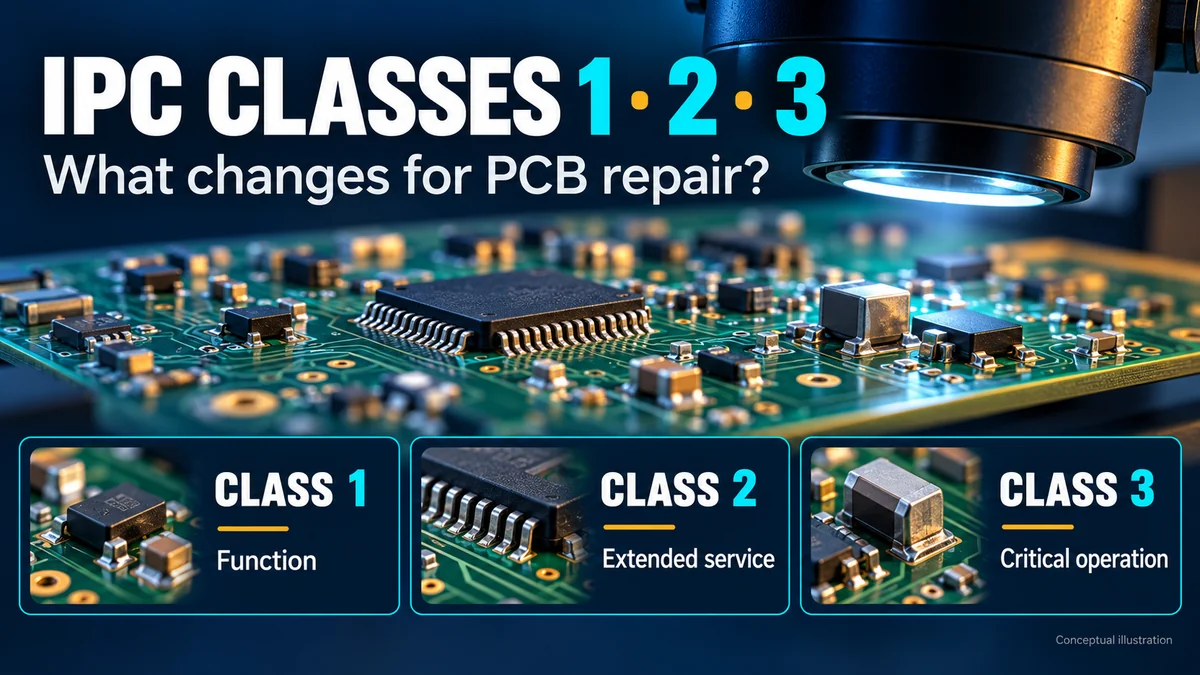
IPC Classes 1, 2 and 3 describe different expectations for an electronic product’s service. Class 1 centers on the completed assembly performing its function. Class 2 adds sustained service and extended life. Class 3 addresses applications where continued operation or operation when needed is critical.
For PCB repair, the class is one part of the acceptance requirements. The standard, revision, approved repair method and required checks matter too. “Repair to IPC Class 3” leaves important questions unanswered.
IPC classes at a glance
| Class | Service expectation | Question to resolve before repair |
|---|---|---|
| Class 1 | The assembly must perform its intended function. | What work and checks are required to make the board acceptable for its application? |
| Class 2 | Sustained performance and extended life matter. Continuous service is desirable, but it is not critical. | Which acceptance requirements and service conditions must the repaired area meet? |
| Class 3 | Operation is critical, including operation on demand. The operating environment may also be unusually harsh. | Who approves the repair, and what evidence is required before the equipment returns to service? |
The service descriptions follow the classification framework in IPC J-STD-001J, Section 1.3. The repair questions are practical planning prompts, not additional IPC class definitions.
The product name alone does not determine its class. A board in a machine may handle a convenience display or a critical control function. Those roles deserve different consideration. Confirm the documented requirement rather than assigning a class from the word “industrial,” “medical” or “automotive.”
First identify which IPC standard applies
“IPC Class 2 PCB” can refer to a bare board, its assembled components or a repair requirement. These are different subjects. A photo of a solder joint cannot establish that every aspect of the board meets a stated class.
| Document | Main role | Why it matters for repair |
|---|---|---|
| IPC-A-610 | Visual acceptability of electronic assemblies. | Helps assess applicable workmanship conditions on the completed assembly. |
| IPC J-STD-001 | Soldered assembly materials, processes and acceptance requirements. | Provides requirements beyond the appearance of a finished joint. |
| IPC-7711/7721 | Procedures for rework, modification and repair. | Helps select a method appropriate to the damage, construction and agreed requirements. |
| IPC-6012 and IPC-A-600 | Rigid bare-board performance and printed-board acceptability, respectively. | Relevant when evaluating the board structure rather than only its component solder joints. |
The 2026 IPC Standards Guidance for Printed Board Assemblies maps these documents to separate stages of fabrication, assembly and repair. Keep those stages distinct when reviewing a supplier’s claim.
A concrete example appears in Textron Systems’ 2023 purchase-order code list. Codes A2 and A3 identify J-STD-001 Class 2 and Class 3 soldering requirements. Codes A5 and A6 separately identify IPC-A-610 Class 2 and Class 3 acceptance requirements. These are that buyer’s order codes, not extra IPC classes.
IPC-A-610 is not permission to alter a product. Its published scope explicitly separates acceptance criteria from authorization for repair or modification. It also directs readers to J-STD-001 for X-ray guidance rather than presenting A-610 as an X-ray acceptance standard.
Class 2 vs Class 3: what changes in practice?
Some workmanship limits become tighter
A condition acceptable for one class may be a defect for another. But there is no single percentage that separates every Class 2 joint from every Class 3 joint.
Before applying a solder criterion, identify the package and termination type. Then identify what is being measured: side overhang, joint width, fillet height, hole fill or circumferential wetting. These are separate dimensions. A limit copied from one connection type can be wrong for another.
An inspection record should name the applicable clause and revision, not just state “75%” beside a photograph. Record the feature, measurement basis and result so the next reviewer can understand the decision.
The inspection plan must match the requirement
A class label does not turn a visual inspection into a complete functional or environmental test. A board may look acceptable and still have an intermittent fault. A board that starts on a bench may still have unverified functions.
Define what can be inspected and measured, including hidden connections and any limits of the available setup. For critical equipment, the responsible equipment owner or design authority should also define the checks needed after board repair and before system use.
Cost depends on the actual work
Closer inspection, extra records or a restricted repair method can add effort. There is no reliable universal rule that Class 3 repair costs a fixed multiple of Class 2. Access, damage, component availability and the required evidence can dominate the quote.
Class 3 is not a zero-failure guarantee
Class 3 expresses a critical service requirement. It does not assign a failure probability, promise a lifespan or make every design suitable for every environment.
Reliability still depends on the circuit design, components, board construction, assembly process and operating conditions. Choosing a stricter acceptance class cannot compensate for an unsuitable cooling arrangement or an incorrectly rated component.
Industry-specific addenda may introduce further requirements. For example, the 2025 automotive addendum for the J revisions supplements or replaces identified base requirements when invoked by procurement documents. An addendum must be used with its corresponding base document; it is not a standalone substitute.
Keep the revision with the class
IPC’s revision table, checked on October 27, 2026, lists IPC-A-610J and IPC J-STD-001J as the current base revisions. Both were released in 2024. The class number and revision letter identify different things.
A newer edition does not automatically replace the edition specified for an existing assembly. J-STD-001J states that adopting a newer revision or amendment is not automatic. Review the applicable documents and resolve changes before work starts.
For example, finding an older revision on a board’s original documentation is a reason to clarify the requirement. It is not permission to silently inspect the repair against a different edition.
Can a Class 3 PCB be repaired?
A Class 3 designation does not create a blanket ban on repair. Whether a particular repair is allowed depends on the applicable documents, the damage and the authority responsible for the product.
IPC-7711/7721D addresses rework and repair and connects procedure selection to product class. It also distinguishes manufacturing decisions from work on products that have already failed in service.
A replacement component and a reconstructed copper connection may need different approval and verification. Replacing a part does not establish that a damaged plated hole, nearby laminate or concealed connection is acceptable.
It is also unsafe to assume that reworking a few visible joints upgrades a Class 2 assembly to Class 3. The claim would need support across all applicable requirements, including any relevant original fabrication and process evidence.
For an industrial PCB repair assessment, establish the requested scope and available evidence first. Keep a local repair decision separate from a claim about the compliance of the entire assembly.
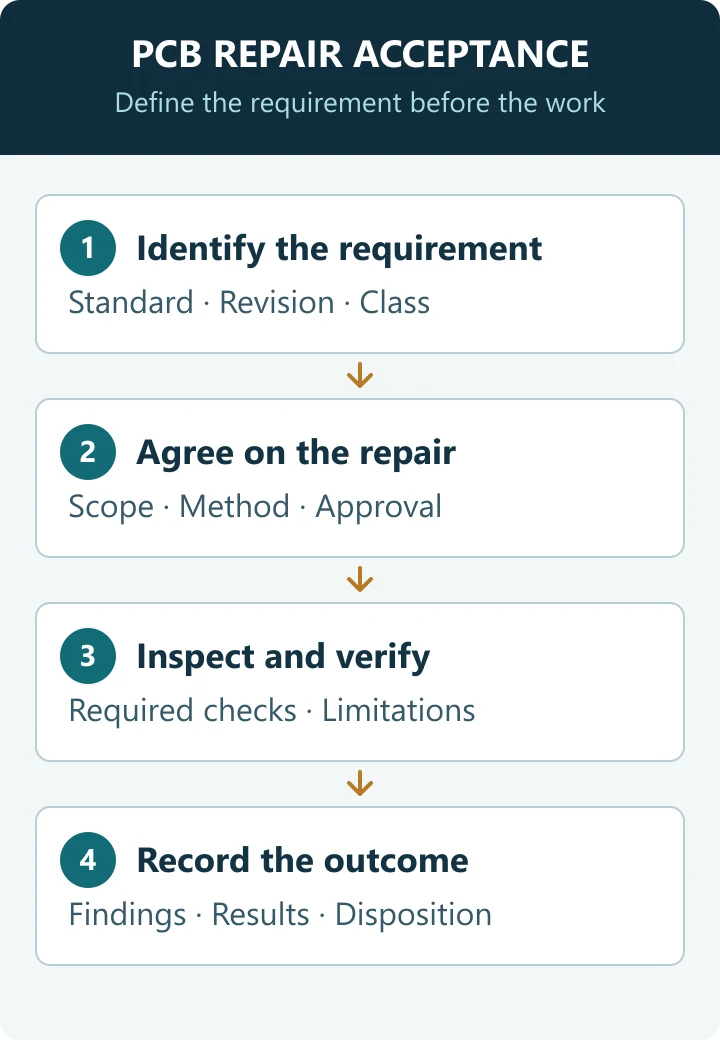
What to send before requesting IPC-based repair
Provide the board identity and fault information, then add the acceptance documents. The following details help turn a broad request into work that can be reviewed:
- Board and assembly revision: part number, clear photos of both sides and any available drawings.
- Required standard and edition: the exact document, revision, class and applicable addenda.
- Reported problem: symptoms, error codes, prior repairs and test results.
- Allowed work: component replacement, connection repair or other defined actions, including approval requirements.
- Required evidence: inspection records, measurements, photographs and functional checks.
- Return-to-service conditions: checks that need the complete machine, load or specialist equipment.
If the original class is unknown, say so. Agree on an assessment scope and record the limitation instead of selecting Class 2 by habit.
The PCB Reborn repair process starts with board information and an agreed scope. Send the available documents with your board photos before shipment, especially where a specific acceptance standard is required.
Frequently asked questions
What is the main difference between IPC Class 2 and Class 3?
Class 2 covers products needing sustained performance and extended life where uninterrupted service is desirable but not critical. Class 3 addresses critical continued operation or operation on demand. Apply the specific acceptance criteria in the agreed standard and revision.
Should every industrial control board default to Class 2?
No. “Industrial” does not identify the consequence of a board failure or its documented acceptance requirements. Confirm the function, operating environment and applicable product documentation before selecting a class.
Does IPC-A-610 Class 3 mean a product can never fail?
No. The class describes service expectations and associated acceptance requirements. It does not guarantee zero failures, a particular operating life or suitability for every environment.
Can repairing a Class 2 assembly make it Class 3?
Not by repairing a few joints alone. A Class 3 claim needs evidence that all applicable requirements are met. The original board construction, assembly process, documentation and required verification may also matter.
Is an IPC personnel certificate the same as product compliance?
No. Personnel certification concerns an individual’s knowledge or skills within its stated scope. Product conformity and manufacturing-process qualification need their own evidence. The IPC QML program separately addresses providers’ assembly processes.
Are Class 3/A and “Class 4” additional IPC-A-610 assembly classes?
IPC’s general product framework has three classes. Special addenda and other board specifications must be identified by their exact document and revision. Do not treat “Class 3/A” or an informal “Class 4” label as a universal fourth assembly class.