
Conformal Coating vs Potting: Protection and Repairability
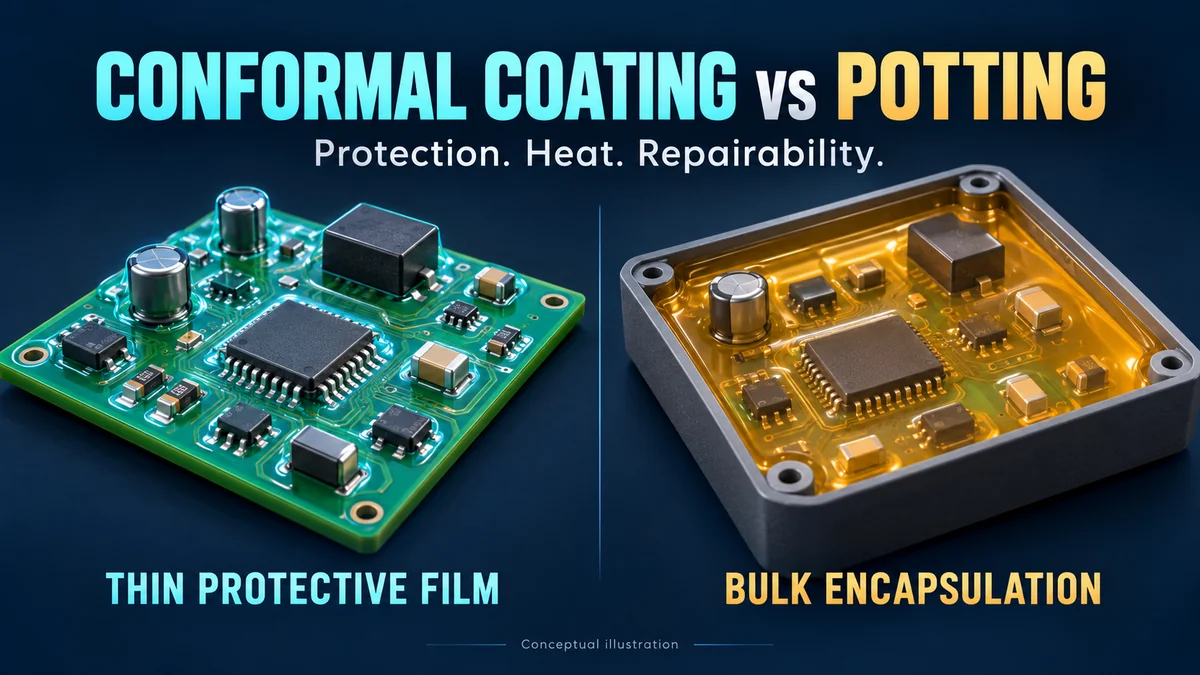
Conformal coating covers a circuit board with a thin protective film. Potting fills a defined space around components with a resin or similar compound. The choice affects moisture protection, heat flow, weight and how much of the board remains accessible for repair.
Start with the expected exposure and the enclosure. Then consider what happens when a component fails. A protection method that suits a sealed module may be a poor fit for a control board that needs periodic inspection or repair.
Conformal coating vs potting at a glance
| Factor | Conformal coating | Potting |
|---|---|---|
| Coverage | A film follows board and component surfaces; designated areas stay uncoated. | A compound surrounds components within a selected volume, often inside a housing. |
| Environmental protection | Helps protect coated surfaces from moisture and contamination when correctly selected and applied. | Can provide a substantial barrier, but interfaces, voids and material compatibility still matter. |
| Weight and space | Usually adds relatively little material. | Uses more material; added mass depends on fill volume and density. |
| Heat flow | Usually leaves the original cooling arrangement largely accessible. | May improve a designed thermal path or make cooling worse if that path is inadequate. |
| Mechanical behavior | Offers limited bulk support; performance depends on the formulation. | Can support components, but cure shrinkage and thermal expansion can also create stress. |
| Inspection and repair | Local access may be practical after suitable coating removal. | Access ranges from manageable to destructive, depending on compound and geometry. |
| Production process | Requires coverage control, masking and a verified cure. | Requires fill control and, for multi-part systems, accurate mixing and a verified cure. |
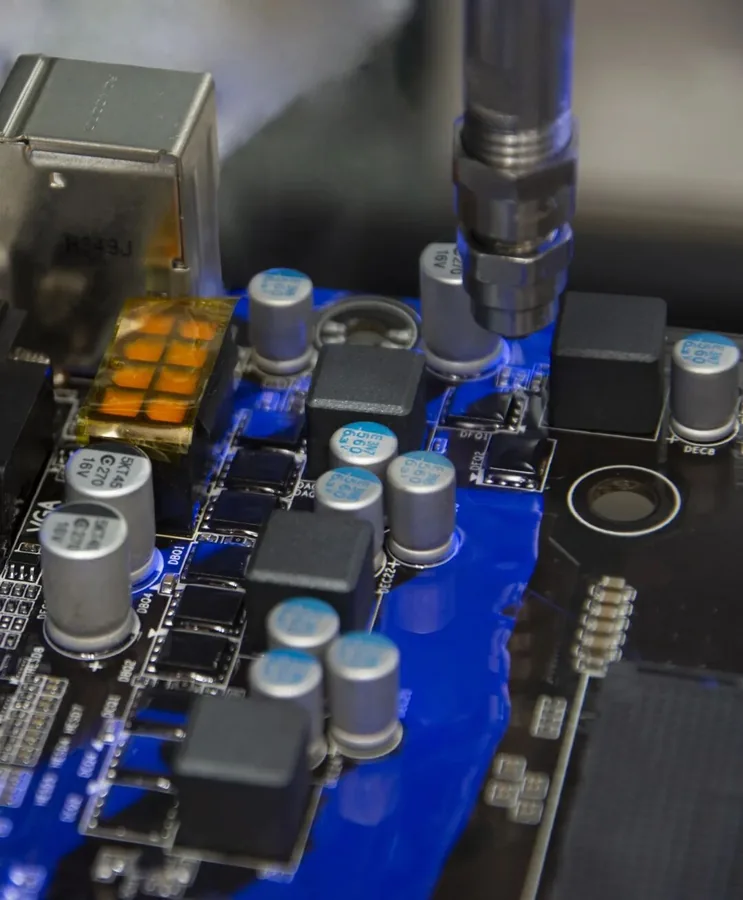
These are selection factors, not a performance rating. Coatings and potting compounds each include very different chemistries. The SCS comparison of potting and conformal coating provides a useful overview of their physical differences.
How much material does each method add?
There is no single thickness specification for every conformal coating. Use the selected product’s technical data and the assembly requirements. For example, the MG Chemicals application guide lists typical single-coat thicknesses of 20–30 micrometers for several products and 65–85 micrometers for its 4200UV coating. Those are product examples, not interchangeable targets.
Potting depth follows the module geometry and required coverage. A quoted “typical” depth is not a universal minimum for electrical insulation, immersion resistance or mechanical protection.
A simple calculation shows why volume matters. Over a flat area of 100 cm², a 50 µm film occupies 0.5 cm³. A 2 mm fill over the same area occupies 20 cm³: 40 times the volume. This illustration ignores components, displacement, edges and losses. It does not mean 40 times the weight or cost, and neither thickness is a design recommendation.
Which offers better moisture protection?
Ask what “moisture” means in the application. Humid air, condensation, salt contamination, occasional splashes and prolonged immersion create different demands.
A well-applied coating can be useful where the enclosure already limits direct exposure. It is not a reason to ignore seals, cable entries or condensation inside the housing. Contamination left beneath a film can also undermine protection. Electrolube discusses cleaning and environmental exposure in its guidance on conformal coating of printed circuit boards.
Potting may suit a module that needs a more extensive material barrier. But resin alone does not prove that the finished assembly is waterproof. Water can exploit a poorly bonded interface, a cable exit or an unfilled region. Chemical resistance must also match the actual fluid, concentration, temperature and exposure time.
For either method, define the exposure first and test the completed assembly. Do not infer an IP rating from the presence of coating or resin.
Potting changes heat flow and mechanical stress
Potting is not automatically a heat sink. Heat still needs a path from the component, through the compound and interfaces, to a surface that can release it.
Some filled compounds are designed for thermal conduction while maintaining electrical insulation. Master Bond describes thermally conductive potting epoxies that use this approach. That capability belongs to the selected formulation and assembly design; it cannot be assumed for an unspecified resin.
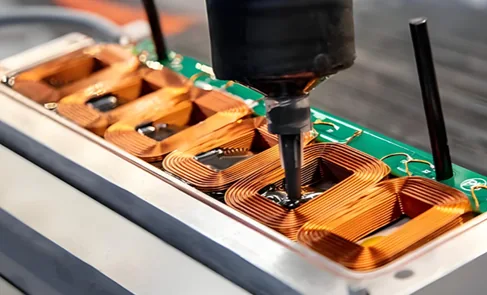
Mechanical protection involves a similar tradeoff. Supporting a tall component may reduce movement. A stiff compound can also transmit stress as the board and materials expand at different rates. Cure shrinkage and the heat released during curing deserve attention, especially in a large fill.
Check the supplier’s limits for mixing, batch size, fill depth and cure conditions. Then assess the actual assembly under its expected temperature and mechanical conditions. The manufacturer-authored Electrolube comparison explains why enclosure design, application conditions and processing must be considered together.
Which method is easier to repair?
Conformal coating usually leaves less material between the technician and the fault. That can make diagnosis and local component access more practical. It does not mean every coating is easy to remove.
Removal must suit the chemistry, substrate and nearby components. MG Chemicals, for example, identifies removal options for its 4223 polyurethane coating. That guidance does not apply automatically to another polyurethane, a silicone coating or a cured two-part system.
Potted PCB repair is a case-by-case decision. A soft silicone compound may allow controlled access. A rigid epoxy around fine traces or fragile components may make removal impractical. The Master Bond potting and encapsulation selector even identifies an easily repairable silicone product, which illustrates why “all potting is permanent” is too broad.
Before removal, identify the likely fault location and estimate the risk of reaching it. The economic question matters too: a technically possible repair may take more time than replacing the module.
Restoring protection is part of the repair
Replacing a failed component is only one step. The repaired area may also need cleaning, drying, inspection and compatible protective material. Confirm the required coverage and cure before returning the board to service.
A bench functional test does not, by itself, demonstrate restored immersion resistance, high-voltage insulation or environmental qualification. Agree on the required checks for the board’s application as part of the repair process.
Can you use conformal coating and potting together?
Yes. A design may use coating over much of the board and local potting around selected components. The combination needs a defined purpose, such as protecting one exposed region while keeping other parts accessible.
There is no universal “coat first” or “pot first” rule. The right process depends on adhesion between materials, surface condition, cure state, access and the intended interface. Confirm compatibility with the material suppliers and validate the proposed sequence on representative assemblies.
Keep-out areas also need deliberate control. Connectors, test points and other functional interfaces may need masking or selective application. The MG Chemicals coating guidelines cover cleaning, masking, curing and inspection as separate process steps. Visible coverage alone does not establish that every requirement has been met.
Choose around the exposure—and the next repair
Conformal coating is often worth considering when low added mass, limited space and service access matter. Potting is worth considering when the design calls for bulk protection or component support and can accommodate its material, thermal and repair consequences.
Before deciding, document the enclosure, likely contaminants, temperature range, cooling path, insulation requirements and expected service life. Include the repair strategy. “Indoor” and “outdoor” are not complete specifications.
If you need a repair assessment, send PCB Reborn clear photos of both sides of the board, its identification label and the fault symptoms. Include the coating or potting product name if available. Photos and material information help establish whether the affected area can be inspected and accessed before you ship the board.
Frequently asked questions
What is the main difference between conformal coating and potting?
Conformal coating forms a thin film over selected board and component surfaces. Potting fills a defined space around components with a protective compound. Potting generally uses more material and changes access for inspection and repair.
Does potting make a PCB waterproof?
Not automatically. Waterproof performance depends on the compound, adhesion, voids, housing, cable entries and exposure conditions. Test the completed assembly against the required conditions rather than assuming a rating from the resin alone.
Can a potted circuit board be repaired?
Sometimes. The compound’s hardness, adhesion and depth affect access. Component location and board condition also matter. Soft materials may allow local removal, while rigid compounds can make access too damaging or costly.
Is encapsulation the same as potting?
The terms overlap in electronics protection. Potting commonly describes filling a housing or defined cavity around an assembly. Encapsulation is a broader term for surrounding parts with protective material. Specify the actual geometry and process rather than relying on the name alone.
Is silicone a conformal coating or a potting material?
It can be either. Silicone describes a material family. A thin silicone film can serve as a conformal coating, while a silicone compound can fill a module as potting. Check the specific product and application method.
Should conformal coating be applied before or after local potting?
There is no universal order. Follow a process validated for the chosen materials, cure conditions, surfaces and interface. Confirm compatibility and adhesion instead of assuming that one sequence suits every assembly.